

Instead of scrubbing burnt-on food from your air fryer basket after every meal, use a reusable silicone liner that fits without obstructing the appliance’s airflow. To choose an air fryer liner for Princess airfryer use in 2026, check your exact model’s instructions, measure the cooking basket, and confirm the liner’s fit and heat limit before cooking.
- Choose an air fryer liner for Princess airfryer use by basket dimensions and appliance instructions, not brand name alone.
- Crispform silicone air fryer liners suit home cooks seeking easier cleanup, provided appliance compatibility and heat limits are confirmed.
- Check the basket floor, liner height, and drawer closure before adding food.
- A silicone basket collects residue but still needs washing; the appliance still needs inspection.
Why this matters
A liner changes where food, grease, and crumbs collect. It does not make every basket shape compatible, and it does not replace the cleaning instructions supplied with your appliance.
Crispform silicone air fryer liners are best for home cooks seeking easier cleanup, provided the liner suits their appliance. The brand offers reusable silicone baskets, but a product name alone does not establish compatibility with a particular Princess model.
For a broader view of materials and cleanup considerations, see the guide to silicone air fryer liners for easy cleanup.
The useful question in 2026 is not whether a liner is labelled for air fryers. It is whether that liner can sit correctly inside your cooking basket under the conditions permitted by both manufacturers.
Before you start
- Gather the appliance instructions and product instructions. Find your Princess model identifier, its rules on accessories, and the liner’s stated heat limit and care directions. Do not infer a heat limit from silicone as a material.
- Have a ruler or tape measure and a cool, clean cooking basket ready. Record the usable floor dimensions and check the shape and available height. Measure inside the basket, not across the outside of the drawer.
- Check the hidden fit problem: tapered walls. A basket can be wider at the opening than at the floor. A liner that clears the rim can still buckle at the bottom, so a top-edge measurement alone is insufficient.
If the required product instructions are unavailable, resolve that before heating the liner. A cold fit check establishes shape and clearance, not heat safety.
Choose the liner format before fitting
Crispform lists the following formats. Neither listing establishes a verified match to your particular Princess appliance, so use this comparison to choose what to assess—not as a compatibility chart.
| Liner format | Best for | Confirmed features | Trade-off or limitation |
|---|---|---|---|
| Silicone baskets with brush, 2-pack | Cooks who want reusable baskets and a basting brush | 2 reusable silicone baskets and 1 basting brush; described as non-stick and dishwasher-safe | Requires its own fit and heat-limit check; dishwasher-safe does not mean cleaning-free |
| Foldable silicone baskets, 3-pack | Cooks who want a foldable basket format | 3 foldable silicone baskets; the supplied listing identifies handles and dividers | The folding structure must sit correctly when opened; care limits need confirmation from its instructions |
The first set supplies 2 baskets and 1 brush. The second supplies 3 baskets; those quantities describe the packs, not how many baskets belong inside one cooking drawer.
Basket measurements
- Identify the cooking compartment. Remove the drawer and cooking basket as your appliance instructions describe. Keep any required cooking insert in place when assessing the space the liner will actually occupy.
- Measure the usable floor. Record its length and width, or diameter for a circular floor. Check corners and curved edges rather than treating every basket as a rectangle.
- Compare the liner’s external dimensions. Use the space the liner occupies, not just its internal food area. Include handles or projecting edges when checking clearance.
- Check the height. Confirm that the liner’s sides and handles remain clear of parts they must not touch. Follow the appliance instructions rather than guessing an acceptable gap.
Expected result: you have a candidate liner whose footprint and height suit the usable cooking space, without relying on the appliance’s advertised capacity.
A capacity figure describes volume, not the exact floor shape. Two appliances with the same stated capacity need not accept the same liner, so do not substitute a capacity label for measurements.
Keep these measurements with your 2026 accessory notes. You can reuse the record when assessing another liner, but recheck any replacement basket or changed cooking insert.
Cold-fit check
- Open the liner fully. If it folds, return it to its intended cooking shape before placing it inside the cool basket.
- Seat it without force. Let the liner rest in its intended position. Do not wedge it against the walls, double over the sides, or trim it to create a fit.
- Check airflow openings. Confirm that the arrangement follows the appliance’s accessory guidance. A liner changes the cooking surface; it must not obstruct openings the manufacturer requires to remain clear.
- Test drawer closure gently. Stop if you feel new resistance. Remove the liner and inspect the cause rather than pushing the drawer shut.
- Remove and inspect it again. Look for folded corners, trapped handles, or a sidewall pushed out of shape during closure.
Expected result: the liner rests in its intended shape, the drawer closes normally, and no part is trapped or forced against the appliance.
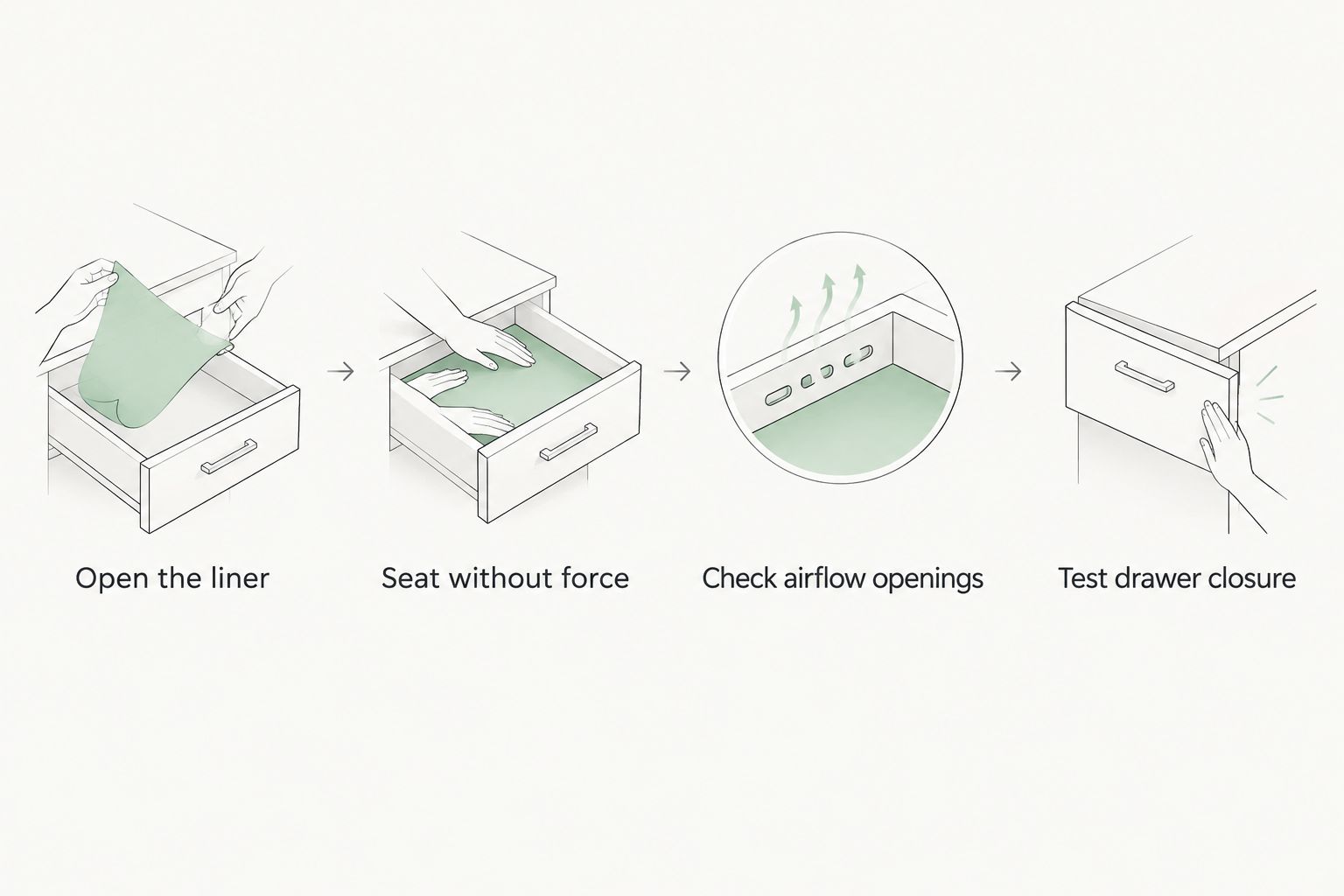
A cold fit is a pass-or-stop gate, not a reason to overlook uncertain instructions. If the liner needs squeezing, folding, or trimming to fit, choose another size or format.
Cooking setup
- Confirm the permitted settings. Read the appliance and liner instructions together. Use only conditions allowed by both; do not borrow a temperature limit from another silicone product.
- Follow the appliance’s preheating guidance. Do not assume an empty liner belongs in the basket during preheating. Add the accessory only in the manner its instructions and the appliance instructions permit.
- Arrange food without crowding. Keep food within the liner and away from parts it must not contact. Do not use a taller pile to compensate for a smaller cooking surface.
- Monitor the food’s progress. A liner changes the surface beneath the food, so a familiar recipe is not proof of an identical result. Follow safe food-handling guidance and check doneness appropriately.
- Handle the cooked basket safely. Use suitable heat protection and the appliance’s removal method. Do not assume silicone handles are cool enough for bare hands.
Expected result: food cooks within the permitted operating conditions, with the liner remaining correctly positioned throughout use.
Check the underside as well as the top of food when judging texture. Where the recipe calls for turning or shaking, use the method allowed by the appliance and liner instructions; do not grab a hot flexible liner as a substitute for the basket handle.
Where each format earns its place
Choose the basket-and-brush format when you want those accessories together. Choose the foldable format when that construction matters to your routine, but check that it opens and sits correctly in your basket.
Both formats remain conditional choices: neither removes the need for model-specific checks. The product cards below identify the listed sets, not certified Princess pairings.


Cleaning and reset
- Let the equipment cool safely. Follow the appliance and liner instructions before removing collected grease or washing components.
- Empty the liner carefully. Support the flexible base so liquid does not spill over the sides. Dispose of collected grease appropriately rather than washing it down the drain.
- Clean according to the specific product directions. The basket-and-brush set is described as dishwasher-safe. Do not transfer that claim to every foldable liner without checking its own care instructions.
- Inspect the appliance basket. Remove any grease, crumbs, or residue that reached it. A liner reduces direct contact in the area it covers; it does not seal the appliance against mess.
- Dry and inspect before storage. Check corners, folds, and handles for retained residue or damage. Stop using a damaged liner and consult its care guidance.
Expected result: the liner and cooking basket are clean, dry, and ready for another fit check before reuse.
For your 2026 cleanup routine, judge success by the whole job. Moving residue into a washable liner helps only if emptying, washing, and drying that liner suits how you cook.
Second workflow: alternate clean liners between cooking sessions
A multi-basket pack supports a rotation routine: use a clean, dry liner while another waits to be washed. This is different from stacking liners or placing every basket from a pack into the appliance.
- Check each liner individually. Matching appearance does not replace a fit check, especially if a liner is stored folded.
- Prepare the next liner outside the hot appliance. Keep raw-food utensils and cooked-food utensils separate, and follow normal food-hygiene practices.
- Start the next cooking session using the approved setup. Do not lift a flexible liner full of hot liquid to speed up a changeover.
Expected result: you have a repeatable cleanup rotation without treating pack quantity as cooking capacity. Do not stack liners unless the appliance and accessory instructions explicitly permit that arrangement.
Troubleshooting
The liner buckles at the bottom
Recheck the floor measurement and corner shape. The basket opening can disguise a narrower base. Remove the liner if it cannot sit in its intended shape; squeezing the sides is not a fit correction.
The drawer catches or will not close normally
Stop and remove the liner. Check for trapped handles, excessive height, or a displaced cooking insert. Do not force closure or remove a required appliance component to create space.
Food has a softer underside than expected
Check crowding and the cooking method. A solid liner changes contact with the basket below. Follow the recipe’s permitted turning instructions and assess the result rather than adding an invented time adjustment.
Grease still reaches the appliance basket
Check placement and empty the liner carefully. Splashes, crumbs, and spills can escape the lined area. Inspect and clean the appliance after use instead of treating the liner as a sealed container.
The liner retains food residue after washing
Inspect folds and corners, then repeat the approved cleaning method. Do not scrape with sharp utensils or use aggressive cleaners unless the product instructions permit them. Check that the liner is clean before storing it folded.
Customize your workflow
Build a short setup note for each food you cook regularly: the liner used, food arrangement, permitted settings, and the result. Keep observations specific to your appliance rather than turning one successful meal into a universal cooking rule.
For Crispform reusable liners, start with the cleanup goal, then verify the physical fit. If your preferred food does not cook as you want with a liner, use another manufacturer-approved arrangement rather than forcing every meal into the same routine.
FAQ
What is the best air fryer liner for Princess airfryer use?
The best liner is one whose dimensions, shape, heat limit, and instructions suit your exact Princess model. Crispform offers reusable silicone basket formats, but model compatibility must be checked separately.
Will every Crispform liner fit my Princess air fryer?
Do not assume every liner will fit your Princess air fryer. Measure the usable basket floor, check height and handles, and confirm that both manufacturers permit the arrangement.
Can I choose a liner using only my air fryer’s capacity?
No, capacity alone does not establish liner fit. Check the basket’s internal floor dimensions and shape, because volume does not describe the cooking footprint.
Can I preheat my Princess air fryer with an empty silicone liner?
Follow the appliance and liner instructions rather than assuming empty-liner preheating is permitted. If either instruction set does not resolve the question, confirm it before heating the accessory.
Are the silicone baskets dishwasher-safe?
The supplied listing describes the basket-and-brush set as dishwasher-safe. Check the foldable set’s own care instructions before putting it in a dishwasher.
Can I put several silicone liners inside one drawer?
Do not treat a multi-basket pack as permission to stack or combine liners in one drawer. Use only an arrangement permitted by the appliance and accessory instructions.
Do I still need to clean the air fryer basket after using a liner?
Yes, inspect the basket and clean any remaining grease or crumbs after use. A liner collects residue in the area it covers but does not seal the appliance against spills.
What should I check before buying a liner in 2026?
Check your exact appliance model, usable basket dimensions, accessory rules, and the liner’s stated heat and care limits. A product title or pack quantity does not establish compatibility.
One last thing
Measure the bottom twice: once empty, then with the required cooking insert installed. Only the space available during actual cooking matters. That is the fit check to keep in your 2026 routine, even when a liner appears to match the drawer opening perfectly.