

Best overall for repeat use: a correctly fitted reusable silicone basket. Best for compact storage: a foldable silicone basket. Best for occasional disposable use: air-fryer parchment approved for your appliance. This 2026 guide compares air fryer liners for Ninja by fit, cooking task and cleanup, including reusable options from Crispform.
- Choose air fryer liners for Ninja by drawer dimensions and appliance instructions, not the Ninja name alone.
- Crispform silicone baskets suit cooks prioritizing reusable air fryer liners and easier cleanup; verify fit before buying.
- Foldable baskets suit compact storage; parchment suits occasional disposable use where appliance instructions permit it.
- A solid liner catches residue but changes airflow beneath food. Match the liner to what you cook.
Why the right liner matters
A liner changes where food, grease and cooking juices sit inside your air fryer. A solid basket contains residue, while a perforated liner lets liquid pass through its openings. Those differences matter more than whether a listing includes the word Ninja.
For a 2026 purchase, start with your exact appliance model and its instructions. Ninja sells different drawer configurations, so a liner described for the brand is not proof that it fits your drawer or is approved for your cooking mode.
Crispform reusable air fryer liners are best suited to home cooks who prioritize containing food residue over leaving the cooking surface uncovered. Fit and permitted use still decide whether a particular basket belongs in your appliance.
What makes the best air fryer liners for Ninja?
Judge every option against these criteria before choosing a material or accessory set:
- Drawer fit: Compare the liner’s external dimensions with the usable interior, including rounded corners and tapered walls.
- Appliance instructions: Confirm whether your model permits the liner material and where it should sit.
- Cooking task: Saucy food needs containment; food needing exposed airflow underneath calls for a different approach.
- Cleaning burden: A reusable basket becomes another item to wash. Disposable paper avoids that task but creates waste.
- Handling and storage: Check whether handles, folds or dividers help your routine without obstructing the drawer.
- Product documentation: Look for stated dimensions, temperature limits and care instructions. Do not substitute assumptions for specifications.
A liner is not automatically the best choice for every meal. Keep the original cooking arrangement when an accessory conflicts with the appliance instructions or the result you want.
Air fryer liner options at a glance
These 2026 picks rank liner types by distinct uses, not by unverified claims about cooking speed or Ninja compatibility. The named basket sets are options to assess against your model, not confirmed model-specific matches.
| Item | Best for | Standout feature | Key limitation |
|---|---|---|---|
| Silicone baskets with brush, 2 units | Containing sticky cooking residue | Reusable baskets supplied with a brush | Fit must be checked; a solid base changes airflow beneath food |
| Foldable silicone baskets with handles and dividers, 3 units | Storage-conscious kitchens | Foldable design with handles and dividers | Handles and dividers need clearance inside the drawer |
| Air-fryer parchment | Occasional disposable use | Paper can be discarded after use | Loose paper must not circulate toward the heating element |
| Perforated reusable liner | Openings beneath food | Holes leave paths through the liner | Grease and juices still reach the basket below |
1. Silicone baskets with brush: best for sticky cooking residue
A reusable silicone basket holds food and cooking residue inside a removable container. Crispform offers a 2-pack with a basting brush, making this the most directly relevant option here for cooks trying to avoid scrubbing burnt-on food from the air-fryer basket.
The reason to choose this type is containment. It is not a promise of identical browning to cooking directly on the original crisping surface, and the supplied brush does not establish compatibility with any Ninja model.
Silicone baskets with brush pros:
- A contained cooking area keeps collected residue inside the removable basket.
- Reusable construction avoids discarding a paper liner after each use.
- The included brush provides a separate tool for applying oil or sauces.
Silicone baskets with brush cons:
- A solid base interrupts direct airflow underneath food.
- Collected liquid stays around the food unless you remove it safely.
- You still need to wash the silicone basket and inspect the appliance drawer.
Best for: Home cooks preparing sticky or sauced food who value residue containment.
Before choosing this set, compare the stated basket dimensions and temperature limit with your appliance instructions. Do not treat the 2-pack as evidence that the baskets fit a dual-drawer Ninja.
Verdict: Buy only after confirming dimensions and permitted use; choose this type for containment rather than maximum exposure underneath food.
2. Foldable silicone baskets: best for compact storage
Foldable silicone baskets suit kitchens where storing another rigid cooking container is inconvenient. Crispform lists a 3-unit set with handles and dividers; those features make this a different choice from a straightforward basket-and-brush set.
Assess the basket in its cooking position, not its folded storage position. Handles and dividers occupy space, so the complete usable shape matters more than the base measurement alone.
Foldable silicone baskets pros:
- Folding provides a storage option that a rigid container does not offer.
- Handles provide designated grip points, subject to the handling instructions.
- Dividers provide physical separation within the basket.
Foldable silicone baskets cons:
- Fold lines, corners and dividers need attention during cleaning.
- Handles require clearance and are not evidence of a cool-touch surface.
- Dividers do not create separately controlled cooking zones.
Best for: Cooks who prioritize storage and want physical separation between ingredients.
Choose this design because the folding and divider features solve a real problem in your kitchen. Food on either side still shares the appliance’s cooking environment; do not assume different ingredients will finish together.
Verdict: Buy if compact storage is the priority and the fully opened basket fits; skip it if you will not use the extra features.
3. Air-fryer parchment: best for occasional disposable use
Air-fryer parchment provides a disposable barrier between food and the cooking surface. Use it only where the appliance instructions permit paper, and follow the paper manufacturer’s temperature and placement directions.
Paper requires particular care because moving air can lift an unsecured sheet. Do not preheat with loose parchment inside, and do not assume food will secure a sheet whose edges extend beyond the loaded area.
Air-fryer parchment pros:
- The liner can be discarded rather than washed after cooking.
- Paper provides separation between food and the surface beneath it.
- Pre-shaped paper offers an alternative to cutting a sheet yourself.
Air-fryer parchment cons:
- Each use creates disposable waste.
- Loose or exposed paper can move toward the heating element.
- Paper is not a reliable container for substantial cooking liquid.
Best for: Occasional users who prefer a disposable option and have an appliance that permits it.
Check whether the product is solid or perforated. Solid paper and paper with holes do not contain drips in the same way, and neither should be treated as permission to ignore cleaning underneath.
Verdict: Buy only for permitted, properly secured use; skip paper whenever its placement or suitability is uncertain.
4. Perforated reusable liners: best for openings beneath food
A perforated reusable liner places a removable layer under food while leaving holes through that layer. It is the relevant alternative when you want a liner but do not want a fully enclosed silicone base.
The trade-off is direct: openings also let grease, crumbs and cooking juices reach the original basket. Perforation alone does not prove that a liner preserves the appliance’s intended airflow.
Perforated reusable liner pros:
- Openings leave paths for air and liquid through the liner.
- Reuse avoids discarding paper after every cooking session.
- A removable layer separates food from the surface directly beneath it.
Perforated reusable liner cons:
- Drips still reach the drawer or basket below.
- Small food fragments can lodge in the openings.
- Material, dimensions and temperature suitability require checking.
Best for: Cooks who want an intervening layer without full liquid containment.
Verdict: Buy if openings matter more than catching drips; skip it if your main goal is keeping cooking residue out of the basket.
Check the fit before you choose
For a 2026 liner purchase, a model number and usable measurements are more useful than a broad compatibility label. Measure the drawer where the liner will actually sit, following the appliance’s required cooking arrangement.
Use this checklist to compare the drawer with the product documentation:
- Base fit: Check length, width or diameter at the resting surface, not only at the drawer opening.
- Corner shape: Compare curved corners and tapered sides, not just the widest dimensions.
- Height clearance: Include the liner walls, handles, food and any required clearance.
- Cooking position: Confirm whether the original crisping plate stays in place and where accessories are permitted.
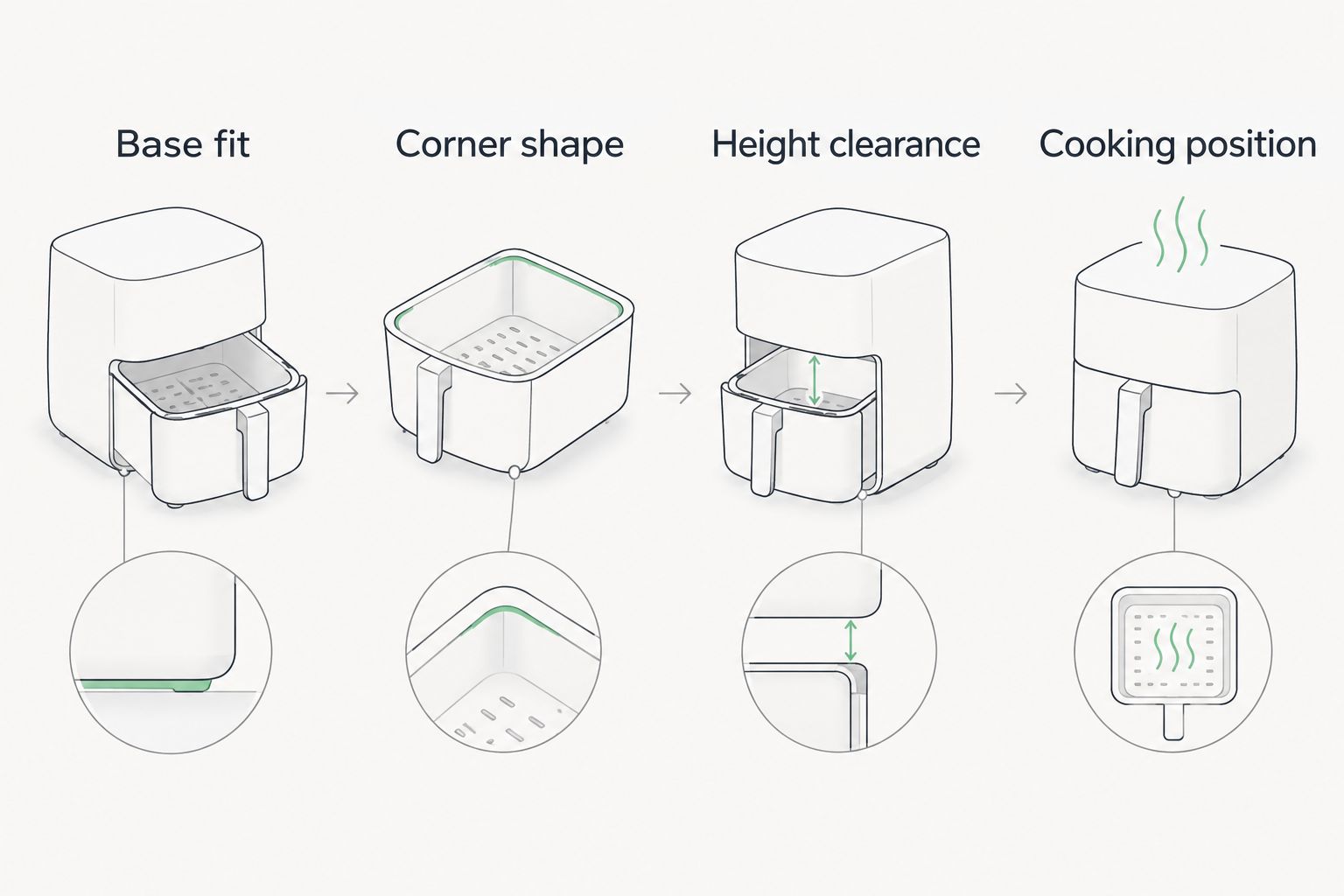
A liner that bends, bunches or prevents normal closure is not a suitable fit. Do not force a basket into place or remove required appliance components merely to accommodate an accessory.
For dual-drawer appliances, assess each drawer separately. A set’s unit count tells you how many pieces it contains, not which drawer shapes those pieces fit.
Use the liner without creating another cleaning problem
Start with the appliance manual and the liner’s care instructions. A liner’s stated temperature limit does not override restrictions on a particular cooking mode or accessory position.
Keep food and residue within the liner’s usable area without overcrowding it. A solid basket collects juices, so check the underside of the food during cooking rather than assuming the original timing produces the same result.
Treat the liner and any collected liquid as hot. Silicone construction does not make food, grease or handles safe to touch, and folding a hot basket is not a substitute for controlled removal.
After cooking, let the appliance cool as directed before cleaning. Remove food and grease from corners, folds and divider joints, then inspect underneath the liner; a removable basket does not eliminate appliance maintenance.
How these liner types are ranked
This 2026 ranking prioritizes the stated cleaning problem: containing burnt-on food residue. Reusable solid baskets therefore lead, followed by a storage-focused variation, disposable paper and perforated liners for different needs.
The comparison uses product features stated in the supplied catalog and material-level trade-offs. It does not assign cooking scores, claim hands-on testing or certify compatibility with a specific Ninja model.
Choose by task first, then confirm fit and instructions. A feature-rich basket that does not fit is a worse choice than a simpler permitted option.
Which air fryer liner should you choose?
For most readers seeking easier cleanup in 2026, start by assessing a plain reusable silicone basket. Crispform offers that category alongside a foldable alternative, but the correct purchase depends on your drawer and cooking habits.
Choose the brush set for a straightforward residue-containment setup. Choose the foldable set when storage and dividers justify the additional cleaning surfaces; choose paper for occasional permitted use, or perforation when catching drips is not the main objective.
The default recommendation is a correctly fitted reusable basket—not a generic promise that any silicone liner fits Ninja. If the documentation does not establish suitability, keep using the appliance’s original cooking arrangement.
FAQ
What's the best type of air fryer liner for Ninja?
A correctly fitted reusable silicone basket is the best starting point when containing cooking residue is your priority. Confirm your Ninja model’s accessory instructions, the basket dimensions and its temperature limit before buying.
Do Crispform silicone baskets fit every Ninja air fryer?
Do not assume universal fit for Crispform silicone baskets. Match the product’s documented dimensions and permitted use to your exact Ninja model and drawer arrangement.
Are silicone liners better than paper liners?
Silicone liners are better for repeated use and liquid containment; paper suits occasional disposable use where permitted. Solid liners in either material change the barrier beneath food, so select the type for your cooking task.
Can I preheat a Ninja air fryer with a paper liner inside?
Do not preheat with loose paper inside the air fryer. Moving air can lift unsecured paper toward the heating element; follow your model’s instructions for any permitted paper use.
Will a liner stop food getting crispy underneath?
A solid liner changes airflow and holds juices beneath food, which affects the cooking conditions at the underside. Check the food during cooking rather than expecting the same result as an uncovered crisping surface.
Can I use a liner without the original crisping plate?
Keep the original crisping plate arrangement unless your appliance instructions explicitly permit a different setup. A liner does not establish that a required component can be removed.
Do I still need to clean the air-fryer drawer?
Yes, inspect and clean the drawer as directed even when you use a liner. Grease, crumbs and cooking juices can reach areas outside or beneath the liner.
One last thing
The liner that catches the most liquid also keeps that liquid near your food. That is useful for residue containment, but it explains why the best cleanup accessory is not automatically the best choice for a dry underside.
Before buying, identify the meal that causes your worst scrubbing. Choose a liner for that task rather than expecting one accessory to improve every recipe.