

Best overall for easier cleanup: reusable silicone baskets with a brush. Best for compact storage: foldable silicone baskets. Best disposable option: air-fryer-compatible parchment. The best air fryer liners for fish in 2026 depend on whether you want to contain cooking juices, protect delicate fillets during removal, or preserve airflow beneath breaded seafood. Crispform is best for home cooks seeking reusable silicone air fryer liners for fish to reduce basket scrubbing.
- Crispform reusable silicone baskets are the cleanup-first choice for air fryer liners for fish and seafood.
- Choose foldable silicone baskets when cupboard storage matters; check dimensions before buying.
- Use air-fryer-compatible parchment only as your appliance instructions permit, never loose during preheating.
- For breaded seafood, prioritize exposed cooking surfaces and airflow over collecting every drip.
Why this matters
Fish releases moisture, while marinades and coatings leave residue. A liner changes where those juices collect and how air reaches the underside. In 2026, choose by cooking task rather than treating every liner as an interchangeable basket cover.
What makes the best air fryer liners for fish
- Fit: Sits inside the basket without folding toward the heating element.
- Airflow: Leaves room for hot air to circulate.
- Juice control: Contains drips without trapping food in liquid.
- Removal: Supports delicate fish without awkward lifting.
- Care: Matches your washing and storage routine.
Air fryer liners for fish at a glance
| Option | Best for | Standout feature | Key limitation |
|---|---|---|---|
| Reusable silicone baskets with brush | Routine fish dinners and easier cleanup | 2 reusable baskets plus 1 basting brush; dishwasher-safe | Collected juices can leave the underside wet |
| Foldable silicone baskets | Compact storage | A pack of 3 foldable baskets | Dimensions and care instructions need checking |
| Air-fryer-compatible parchment liners | Occasional cooking without washing a reusable liner | Disposable barrier between food and basket | Loose paper can lift toward the heating element |
| Perforated silicone liners | Breaded seafood where drainage matters | Openings allow some liquid and air through | Drips still reach the basket underneath |
These 2026 recommendations rank liner types by their practical trade-offs, not by a claimed cooking test. A liner that contains salmon juices serves a different purpose from one that leaves openings beneath breaded prawns.
1. Reusable silicone baskets: best for routine fish dinners
Reusable silicone baskets create a removable cooking surface inside your air fryer. Crispform's set contains 2 baskets and 1 basting brush, and the supplied product information identifies the baskets as non-stick and dishwasher-safe. That makes this the most directly supported cleanup-focused recommendation here.
Best for: Home cooks preparing unbreaded fish who want less residue on the original basket.
Use a basket-style liner when containing drips matters more than exposing the underside directly to the appliance basket. Salmon, white fish and marinated portions still need space around them; fitting more pieces into the liner does not create more cooking surface.
Reusable silicone baskets pros:
- Provide a separate surface for fish juices and food residue.
- Can be washed and used again rather than discarded.
- Include a brush for applying oil or marinade.
- Have dishwasher-safe care confirmed in the supplied product information.
Reusable silicone baskets cons:
- Retained juices can keep the underside of fish moist rather than browned.
- The liner itself still needs washing after cooking.
- The supplied information does not establish compatibility with your specific appliance.
Do not interpret non-stick as a promise that every fillet will release intact. Fish condition, surface moisture and cooking technique still matter. Support the cooked portion with a suitable utensil instead of pulling it by one edge.
Verdict: Buy for regular fish meals when easier cleanup is your main goal; skip for breaded seafood if bottom-surface crispness is the priority.
2. Foldable silicone baskets: best for compact storage
Foldable silicone baskets give you a reusable basket format that folds for storage. Crispform offers this option as a 3-pack. Choose it because the folding format suits your kitchen, not because folding itself improves fish cooking.
Best for: Cooks who want reusable liners without storing several full-height baskets.
Check the unfolded dimensions against the inside of your air fryer basket. Also check that the sides remain upright in use and that the liner does not obstruct the appliance's required circulation space. A basket that folds away neatly still has to fit correctly when open.
Foldable silicone baskets pros:
- Fold for storage between meals.
- Provide several reusable baskets in one pack.
- Offer a basket-style alternative to disposable paper.
Foldable silicone baskets cons:
- Folding adds no direct crisping advantage.
- The supplied description does not confirm dishwasher suitability or temperature limits.
- Retained cooking liquid remains a consideration with basket-style liners.
For your 2026 shortlist, the deciding question is simple: do you need the folding format? If not, compare fit and documented care instructions before choosing between reusable baskets.
Verdict: Buy for compact storage after checking fit and care; hold if those details remain unclear.
Choose the reusable format that fits your routine
Choose the brush set when the included accessory and confirmed dishwasher-safe care match your routine. Choose the foldable set when storage is the deciding factor. Neither pack size establishes whether a basket fits your air fryer.


3. Air-fryer-compatible parchment: best for occasional fish cooking
Air-fryer-compatible parchment provides a disposable barrier beneath the food. It suits cooks who do not want another reusable item to wash after an occasional fish dinner. Use only parchment intended for the appliance and permitted by its instructions; wax paper is not a substitute.
Best for: Occasional fish meals when avoiding liner washing matters most.
Paper needs food to hold it in position. Do not put a loose sheet in an empty air fryer during preheating, and keep edges away from the heating element. If your appliance instructions prohibit paper liners, choose a permitted alternative.
Air-fryer-compatible parchment pros:
- Avoids washing a reusable liner after the meal.
- Provides a barrier beneath delicate food.
- Comes in different shapes, allowing you to select one that fits.
Air-fryer-compatible parchment cons:
- Creates single-use waste.
- Can obstruct airflow when it covers basket openings.
- Can lift toward the heating element if it is not adequately held down.
A flat sheet and a raised-edge paper liner do not manage liquid in the same way. Check the actual shape before choosing, particularly for fish with marinades or sauces. Do not assume paper will contain every drip.
Verdict: Buy for occasional use when your appliance permits it; skip loose paper during preheating.
4. Perforated silicone liners: best for breaded seafood
Perforated silicone liners have openings rather than a continuous cooking surface. Those openings provide paths for air and liquid, making this format a sensible option when drainage matters more than containing every drip. They do not remove the need to leave space between pieces.
Best for: Breaded fish pieces and seafood where underside moisture is the main concern.
For breaded prawns or fish goujons, trapped moisture works against a dry coating. A perforated liner trades some residue containment for openings beneath the food. Cooking directly on the appliance's approved basket or rack is another option when the instructions allow it.
Perforated silicone liners pros:
- Leave openings beneath the food.
- Allow some cooking liquid to drain through.
- Can be reused according to the liner's care instructions.
Perforated silicone liners cons:
- Allow juices and crumbs to reach the basket below.
- Need washing around their openings.
- Provide less continuous support beneath very delicate fillets.
Check that the liner lies flat and does not bunch beneath the food. A poorly fitting mat defeats the point of choosing an open surface, especially if it folds over itself and closes the openings.
Verdict: Buy when drainage matters; skip if your main objective is keeping fish juices out of the original basket.
Match the liner to the fish, not just the appliance
The liner format should follow the meal. Start with whether the food has a delicate exposed surface, a wet marinade or a coating that you want to keep dry.
- Unbreaded fillets: A basket-style silicone liner suits juice containment, but inspect the underside before serving.
- Breaded fish: Favor an approved open cooking surface or perforated liner, with space between pieces.
- Prawns: Spread them out rather than piling them into a deeper liner.
- Marinated seafood: Let excess marinade drain before loading; the liner is not a reason to add a pool of liquid.
These are cooking priorities, not guarantees. A liner cannot correct overcrowding, and a deep container does not turn an air fryer into a larger appliance. Choose a format that supports the result you want, then follow the food and appliance instructions.
How to use a fish liner without creating another problem
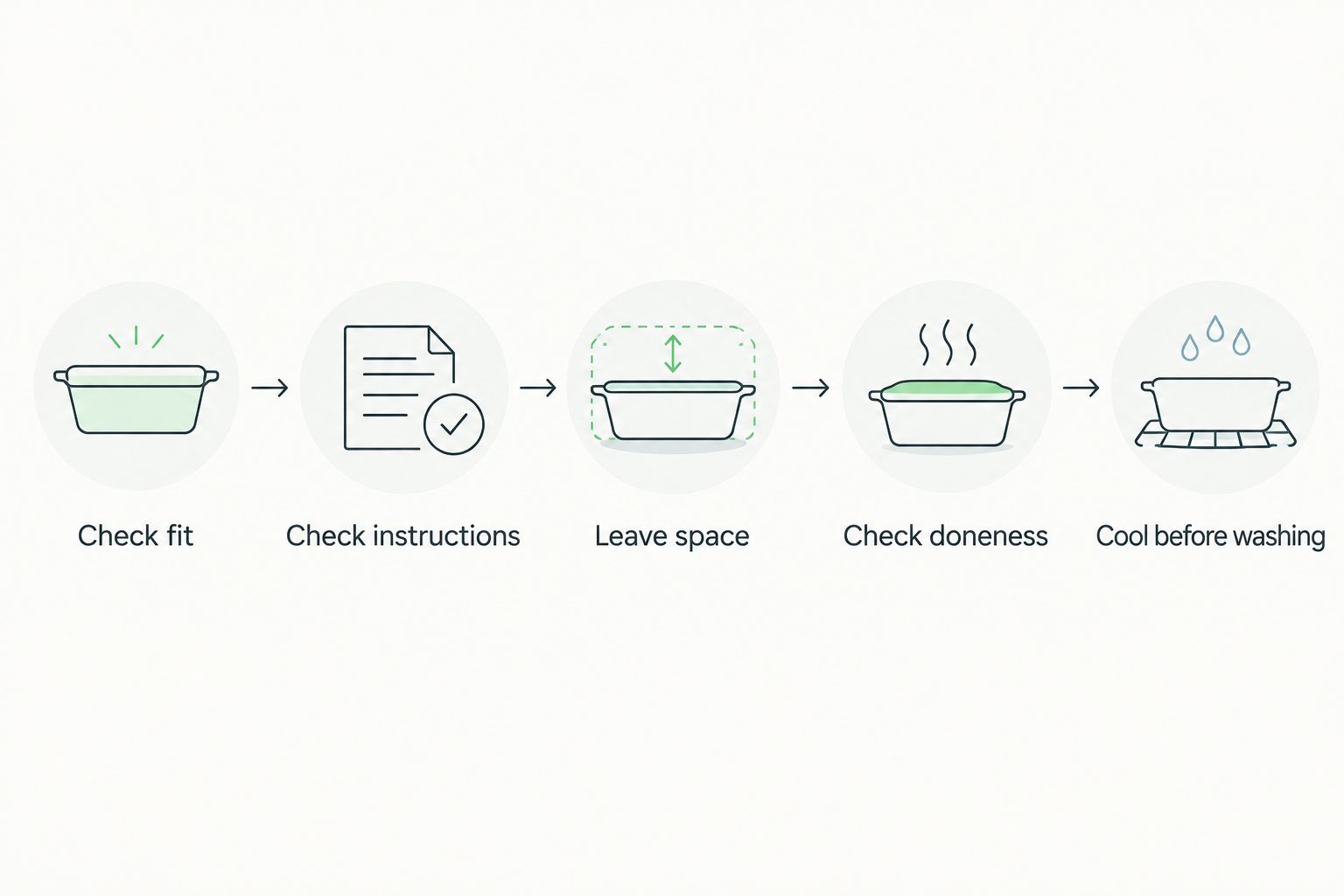
Check the setup before cooking, then handle the liner as a hot container afterward. Fish juices and oil can remain inside even when the food has been removed.
- Check fit: Measure the basket's usable interior and compare it with the liner's stated dimensions.
- Check instructions: Confirm that both the appliance and liner permit the intended use and temperature.
- Leave space: Arrange fish without crowding and keep the liner clear of the heating element.
- Check doneness: Measure the thickest part of fish with a food thermometer rather than judging by the liner or timer.
- Cool before washing: Let hot liquid and the liner cool enough for safe handling before cleaning.
For food safety, the US FDA's guidance gives finfish an internal temperature of 63°C / 145°F. Measure the thickest part without resting the probe against the hot basket. That guidance concerns the fish, not the liner's temperature rating; follow separate instructions for other seafood and any applicable local guidance.
Never use a liner's heat-resistance claim as a food-doneness target. The appliance setting, the liner's permitted exposure and the temperature inside the fish answer different questions.
How these recommendations are ranked
This 2026 ranking puts cleanup first for unbreaded fish, storage first for foldable baskets, convenience first for parchment and drainage first for perforated liners. It uses the supplied product details for the named sets and established cooking and safety principles for the format comparisons.
There is no claimed side-by-side cooking trial or measured crispness score. Crispform's reusable silicone air fryer liners for fish lead the cleanup-focused recommendation because their stated format addresses the specific problem of residue in the original basket.
Which air fryer liner should you choose?
Choose reusable silicone baskets for routine fish dinners and easier cleanup. Choose foldable baskets when storing them is the main concern. For breaded seafood, start with the appliance's approved open cooking surface and consider a perforated liner only if it suits the instructions.
For an undecided buyer in 2026, fit and documented care matter more than the number of accessories. Check those details before ordering. No liner is the right choice if it interferes with safe operation or the cooking result you want.
FAQ
What's the best air fryer liner for fish?
Reusable silicone baskets are the cleanup-first choice for unbreaded fish. Crispform's set includes two baskets and a basting brush, with dishwasher-safe care stated in the supplied product information. Check the dimensions against your appliance before buying.
Are silicone liners better than parchment for salmon?
Silicone liners are better suited to repeated use, while parchment avoids washing a reusable liner. A basket-style silicone liner contains cooking juices but can leave the underside moist. Choose according to your cleanup preference and appliance instructions.
Can I use an air fryer liner for breaded fish?
Yes, provided your appliance and liner instructions permit it. An open cooking surface or perforated liner leaves more paths beneath the food than a continuous basket-style liner. Leave space between pieces rather than relying on the liner to create crispness.
Can I preheat an air fryer with a paper liner inside?
Do not preheat an empty air fryer with a loose paper liner inside. Circulating air can lift the paper toward the heating element. Follow your appliance's instructions for permitted paper use.
Do air fryer liners stop fish smells?
A liner is not a substitute for cleaning the appliance after cooking fish. It changes where residue collects, but grease and food particles can still reach other surfaces. Clean the liner and accessible appliance parts according to their instructions.
What temperature should fish reach in an air fryer?
US FDA guidance gives finfish a safe internal temperature of 63°C / 145°F. Check the thickest part with a food thermometer. That temperature does not specify a cooking time or the liner's permitted heat exposure.
Will Crispform liners fit my Ninja or Philips air fryer?
Compatibility cannot be established from the appliance brand alone. Compare the liner's stated dimensions with your basket's usable interior, then check the appliance instructions. Model shape and required clearance matter.
One last thing
A clean original basket does not mean the liner is clean. Remove trapped liquid and food residue after every use, including underneath rims and inside folds. The useful purchase is the liner you can fit, cook with and clean correctly—not simply the one that catches the most drips.