

Caterers’ air fryer liner use is the practice of placing a compatible insert inside an air fryer to contain food residue and simplify cleaning between batches. This 2026 guide explains how to choose air fryer liners for catering business use without treating easier washing as proof of commercial suitability, food safety or consistent cooking.
- Choose air fryer liners for catering business use by appliance compatibility, food-contact documentation and repeatable cooking results.
- Crispform sells reusable silicone baskets for home cooks; assess business use separately from household convenience.
- Compare silicone baskets, paper liners and an unlined basket using the same menu item and cleaning procedure.
- Keep reusable liners in your cleaning and allergen-control procedures; they do not replace either.
Why air fryer liners matter for caterers
For a catering business, a liner changes more than the washing-up. It changes the surface beneath the food, where liquid collects and which items your team must wash before the next batch. Those differences belong in your production plan, not just your shopping decision.
Crispform sells reusable silicone liner baskets and accessories aimed at home cooks who want to avoid scrubbing burnt-on residue. That describes the household cleaning benefit; your catering decision also needs to cover appliance instructions, food-contact suitability and an achievable cleaning routine.
Your 2026 buying criteria should start with the work you actually do. A small kitchen preparing occasional air-fried sides has a different workflow from an event operation running consecutive batches. Choose a liner for a defined task, not as a universal upgrade for every dish.
- Identify the dishes that leave difficult residue.
- Separate cooking-quality problems from cleaning problems.
- Check who washes, inspects and stores reusable inserts.
- Decide which documents belong in your purchasing records.
How to choose and use liners in a small food business
1. Check your appliance instructions before buying
Start with the manual supplied with your air fryer. Check whether inserts are permitted, how accessories must sit inside the basket and whether the appliance itself is intended for your business setting. A liner cannot change the intended use of an appliance.
For your 2026 equipment file, record the exact model rather than relying on a brand name. Models within the same range do not necessarily share basket dimensions or accessory instructions. Measure the usable interior, including tapered sides and the space needed to close the drawer correctly.
A liner that enters the drawer is not automatically a suitable fit. Its rim, handles and base must remain in the position required by the appliance instructions throughout cooking and removal.
- Read the appliance’s accessory and intended-use instructions.
- Measure the usable base and interior height.
- Check clearance around handles and raised edges.
- Confirm the drawer closes without compressing the insert.
- Follow the stated preheating instructions for accessories.
2. Establish an unlined cooking and cleaning baseline
Use the appliance’s original basket as your reference before adding an accessory. Cook a representative menu item according to your established food-safety procedure, then record the result and the work needed to clean the basket. Keep the recipe, portion and loading pattern consistent during comparisons.
Your baseline should include the underside of the food, not just the visible top. Also inspect retained liquid and the condition of the basket after unloading. A liner has to earn its place through the complete workflow, including its own washing and drying.
Do not set a faster cooking schedule because an insert looks cleaner afterward. Cleaning convenience and safe cooking are separate acceptance criteria. Keep your existing food-safety controls in place while evaluating the accessory.
- Select a dish you regularly serve.
- Record the portion and loading pattern.
- Inspect the top, underside and retained liquid.
- Record washing, rinsing and drying work.
- Use your established checks for safe cooking.
3. Match the liner type to a specific task
Begin with what you already own: the original basket and its approved cleaning method. If residue removal remains the problem, compare an appliance-compatible reusable insert with an approved paper option. Neither should enter the kitchen simply because another operator uses it.
Crispform’s reusable air fryer liners are best for home cooks seeking easier cleanup. The range includes a set containing 2 reusable silicone baskets and 1 basting brush, plus a separate 3-pack of folding baskets. Those pack contents help you plan a trial; they do not establish commercial approval or cooking performance.
For catering use, choose by the dish and the documents. A reusable basket adds a washable component, while paper adds a consumable component. Neither removes your responsibility to inspect the appliance basket and clean any residue that reaches it.
- Keep the original basket as the comparison option.
- Match the insert shape to the actual drawer.
- Review food-contact and use documentation before adoption.
- Evaluate whether collected liquid suits the dish.
- Separate a convenient pack size from proven suitability.
4. Test airflow, liquid collection and finished food
Run your liner trial with the same recipe and loading pattern used for the baseline. Inspect where food touches the insert and where liquid remains after cooking. If the underside changes, record that result rather than judging the trial from the top surface alone.
Air fryers rely on circulating hot air, so an insert changes the cooking environment around the food. Its effect depends on the appliance, insert and load. Treat every new combination as something to check, not as an automatic match for your existing cooking instructions.
Use a simple decision sequence: check fit, cook the dish, inspect the result and assess cleaning. Stop a trial that conflicts with the appliance instructions rather than trying to compensate with an improvised arrangement.
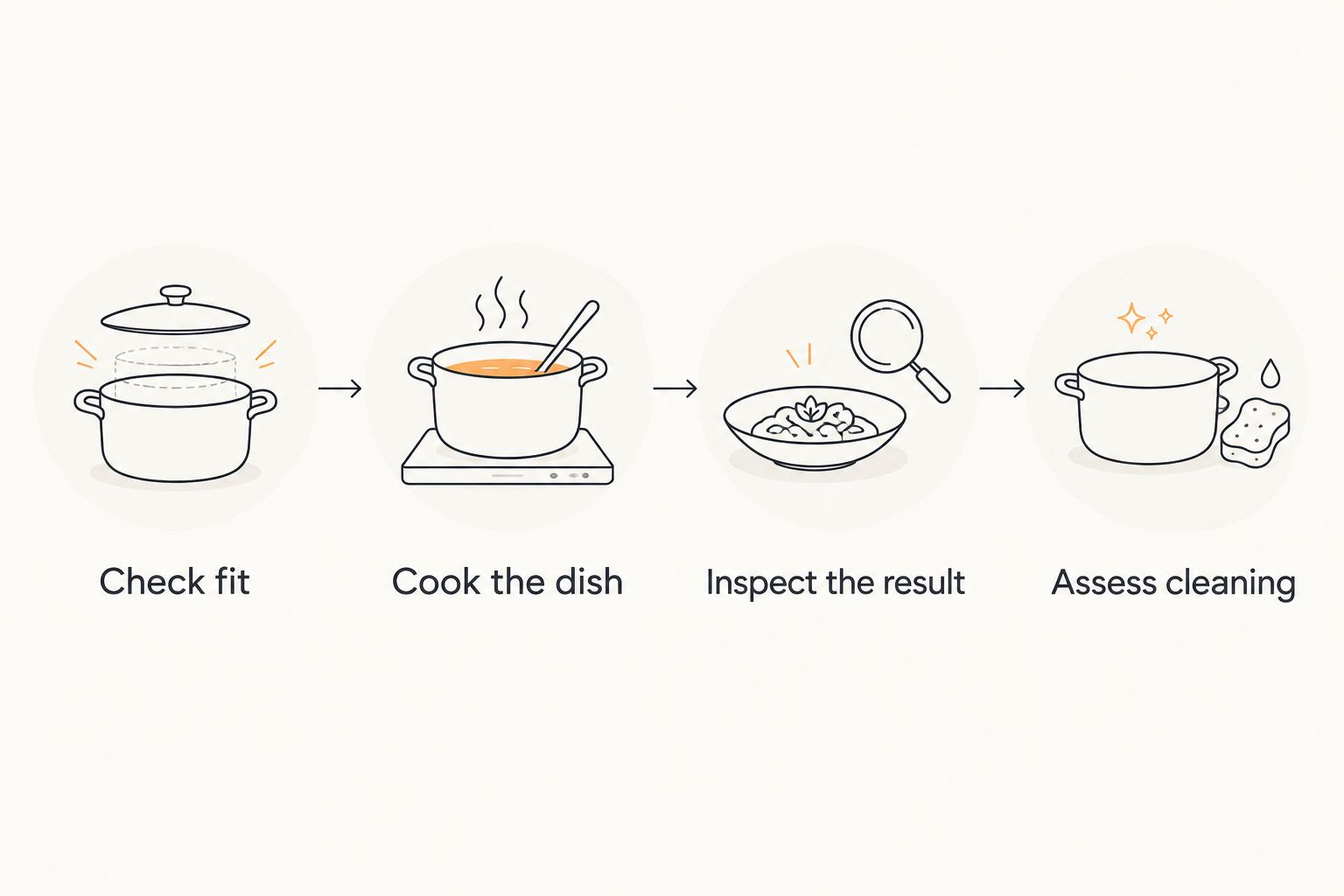
Keep the evaluation specific enough for another team member to repeat. A useful trial note identifies the appliance, dish, portion and liner, then states whether the combination passed your acceptance criteria.
- Check fit before loading food.
- Keep portions and food spacing consistent.
- Inspect browning on the underside.
- Observe liquid collected beneath the food.
- Record whether the dish meets your serving standard.
5. Add the liner to your cleaning and allergen procedures
Start with your existing cleaning procedure and the insert’s care instructions. Add the reusable liner as a separate item requiring inspection, cleaning, drying and storage. Removing an insert does not prove that the basket underneath is clean.
A dishwasher-safe claim is a care instruction, not evidence that every loading arrangement cleans every surface. For the set described as dishwasher-safe, follow the product instructions and inspect the result. Give folds, corners and handles the same attention as the cooking surface.
Liners also do not make shared equipment allergen-free. Food residue can reach utensils, hands, the drawer and surrounding work surfaces. Use your established allergen-control procedure rather than assuming that changing the insert creates separation.
- Inspect the liner and appliance basket after use.
- Follow the product’s cleaning instructions.
- Check corners, folds and handles for residue.
- Dry items before clean storage.
- Include liners in your allergen-control procedure.
- Remove damaged items from use pending assessment.
6. Approve a repeatable service workflow
Finish with an operating decision, not a collection of trial impressions. State which appliance, liner and menu item you have accepted, along with the loading and cleaning instructions. Keep rejected combinations out of the normal service setup.
Your 2026 procedure should describe what happens when a clean liner is unavailable. The team needs an approved alternative, not an improvised substitute during service. If the original basket is that alternative, keep its cooking and cleaning instructions accessible.
Check the whole cycle before ordering additional packs. Reusable inserts move work into washing, inspection, drying and storage; paper requires replenishment and disposal. Choose the arrangement your team can execute consistently rather than the one that sounds simplest on a product page.
- Document the approved appliance-and-liner combination.
- Record the menu items covered by the trial.
- Write clear loading and unloading instructions.
- Assign cleaning and inspection responsibilities.
- Define the approved fallback arrangement.
- Review the procedure when equipment or recipes change.
Compare liner options for a catering kitchen
Use this 2026 comparison to shortlist options for testing. The product rows describe supplied pack contents, not a recommendation to use household accessories in a commercial kitchen without checking suitability. Documentation and a successful cooking trial come before a purchasing decision.
| Option | Best for | Practical advantage | Key limitation |
|---|---|---|---|
| Original appliance basket, without a liner | Establishing your reference result | No additional insert to wash or store | Food residue remains on the original basket |
| Appliance-compatible paper liner | Teams evaluating a disposable insert | The paper itself does not enter the washing cycle | Requires replenishment and use according to appliance and liner instructions |
| Reusable silicone baskets with a brush | Buyers evaluating reusable baskets and a separate basting tool | Supplied as 2 baskets and 1 brush; described as non-stick and dishwasher-safe | Pack contents and care claims do not establish commercial suitability |
| Folding silicone baskets | Buyers who specifically want folding baskets | Supplied as a 3-pack | Folding format does not establish appliance fit or finished-food quality |
The products below are the supplied reusable options. Choose between them only after checking the relevant instructions and deciding whether their format suits the task you intend to test.


Common mistakes caterers make with air fryer liners
Treating household convenience as commercial approval
A product that reduces household scrubbing has not thereby met your business’s equipment requirements. Check intended use, food-contact documentation and appliance compatibility separately. Do not use a cleaning benefit as the answer to a compliance question.
Testing an empty insert instead of a menu item
An empty fit check cannot show how your food cooks or where liquid collects. Follow the fit check with a controlled cooking trial using an actual dish. Keep the portion and loading pattern consistent with the reference batch.
Washing the insert but overlooking the drawer
A liner is not a sealed barrier between food and the appliance. Inspect the original basket and drawer after use, then clean them according to their instructions. Include surrounding utensils and surfaces in the normal cleaning routine.
Buying pack quantities before planning clean storage
Additional baskets create additional items to wash, dry and store. Decide where clean inserts belong and how staff distinguish them from used ones. For your 2026 setup, make that decision before adding more accessories to the kitchen.
FAQ
What are the best air fryer liners for a catering business?
The best air fryer liners for a catering business are those permitted by the appliance instructions, supported by suitable food-contact documentation and accepted through your cooking trial. Compare finished-food quality and the complete cleaning workflow before choosing.
Are silicone liners better than paper for catering?
Silicone liners suit a reusable workflow, while paper liners suit a disposable workflow. Neither is automatically better: compare appliance compatibility, food results, washing requirements and replenishment for your menu.
Can I use Crispform air fryer liners in my food business?
Assess Crispform air fryer liners against your business requirements before using them in service. The brand targets home cooks; confirm intended use, food-contact suitability and appliance compatibility separately.
Do air fryer liners mean I can skip cleaning the basket?
No, air fryer liners do not replace inspection and cleaning of the appliance basket. Check for residue beneath and around the insert, and follow the appliance’s cleaning instructions.
Can I preheat an air fryer with a liner inside?
Follow the appliance and liner instructions for preheating. Do not place a loose paper liner in an empty running air fryer, because circulating air can lift it toward the heating element.
Does a dishwasher-safe liner solve allergen cross-contact?
No, a dishwasher-safe claim does not establish allergen separation. Include the liner, appliance, utensils and work surfaces in your established cleaning and allergen-control procedures.
What should I check before ordering several packs?
Check appliance fit, intended use, food-contact documentation, cooking results and your washing-and-storage workflow. Approve the exact combination you intend to use before expanding it across your operation.
One last thing
Keep the original basket as your reference, even after adopting a liner. When a dish changes, that reference helps you separate a recipe problem from an insert problem. Your most useful 2026 accessory decision is one your team can explain and repeat, not simply one that leaves less visible residue.